OCD Course: CBT & ERP Self-Help
OCD can make you question almost anything. Learn to change the pattern.
Intrusive thoughts, checking, reassurance and mental review can look different from person to person. The repeating OCD cycle is what this course helps you understand. I will guide you through CBT and exposure and response prevention (ERP), then help you choose one workable step to practise in your own life.
26 animation-led lessons · worked examples · fillable worksheets · short knowledge checks
By Dr Elaine Ryan, Chartered Psychologist.
Watch this short video to see if this course is suitable for you
You can also preview a real lesson in the curriculum below.
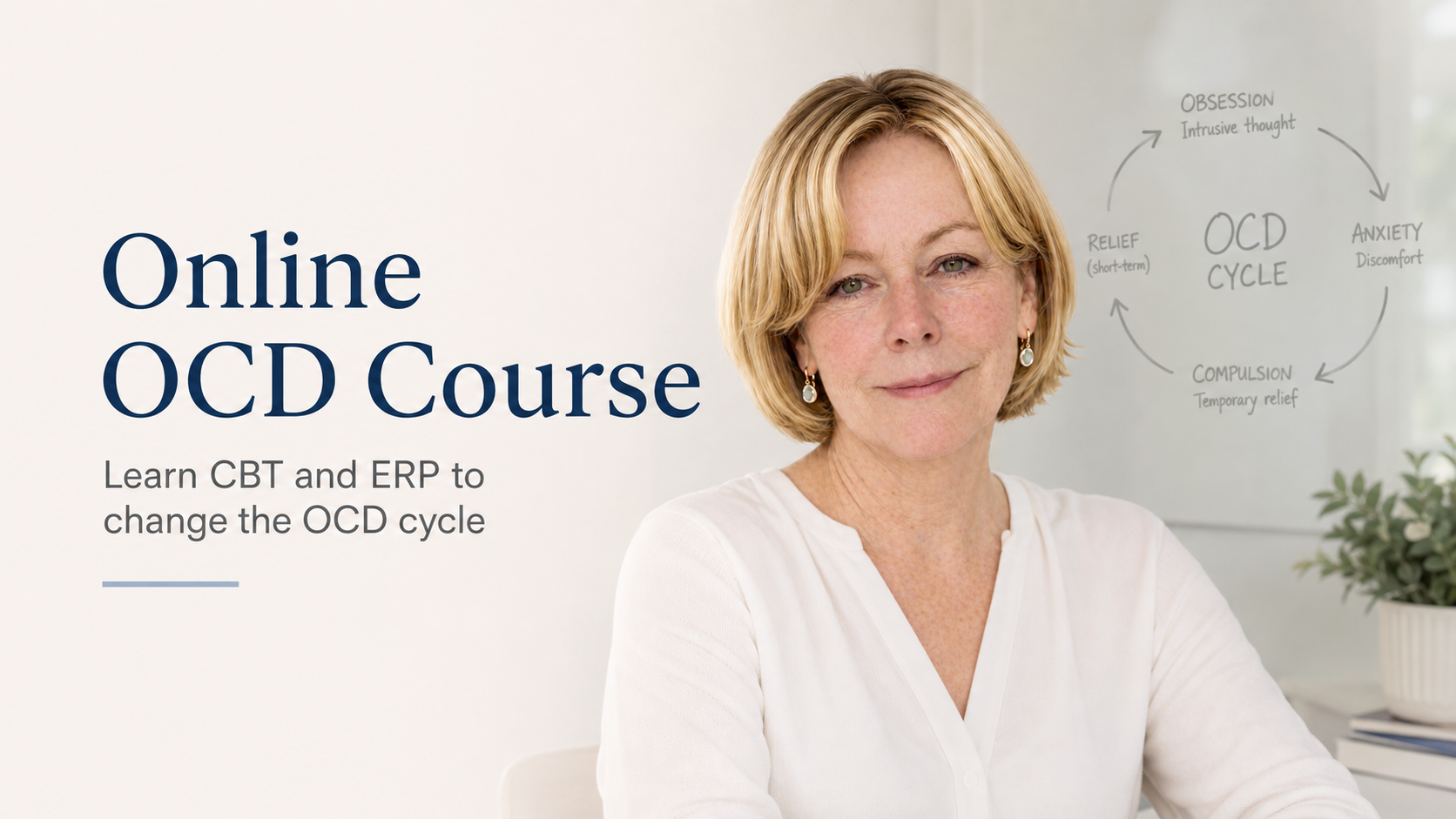
Dr Elaine Ryan
I’m Dr Elaine Ryan, a Chartered Psychologist with more than 20 years’ experience, including work in the NHS. I created MoodSmith to explain OCD and intrusive thoughts clearly, especially the private mental rituals that can be easy to miss. In this course I teach the OCD cycle and ERP step by step, with examples you can apply to your own situation.
Curriculum
- Lesson 19 Checking Contamination and Just Right (5:42)
- Lesson 20 Harm Doubt and Ordinary Safety (5:13)
- Lesson 21 Taboo Thoughts and Ordinary Care (5:03)
- Lesson 22 Identity Doubt and Certainty Tests (5:35)
- Lesson 23 Relationship Doubt and Feeling Checks (5:36)
- Lesson 24 Values and Scrupulosity (5:41)
Perhaps this is the part you recognise
You may check a door, wash again, seek reassurance, or avoid something that matters to you. Or nearly all the work may happen in your head: replaying a memory, analysing a thought, testing a feeling, comparing reactions, or trying to reach complete certainty.
The subject of the doubt can change. The course starts with the pattern that keeps drawing you back into another response. You do not have to reveal the content of an intrusive thought to work through it.
What you will learn to do
1. Map your own OCD cycle. Identify the trigger, the doubt, the visible or hidden compulsion, the brief relief and what happens next.
2. Recognise the extra response. Separate ordinary care, safety and responsibility from repeated checks, reassurance, rumination or avoidance driven by OCD.
3. Plan ERP carefully. Choose a manageable real-life practice step and decide which *extra* ritual you will work on leaving out.
4. Practise and review. Notice what you did, adjust the step, and continue without making a particular feeling or perfect certainty the measure of success.
5. Apply the method across themes. Use examples involving harm doubts, unwanted sexual or other taboo thoughts, identity and attraction checks, relationships, moral or religious doubt, washing, checking and “just right” rules.
6. Keep the skill going. Make a plan for setbacks and return to activities you value.
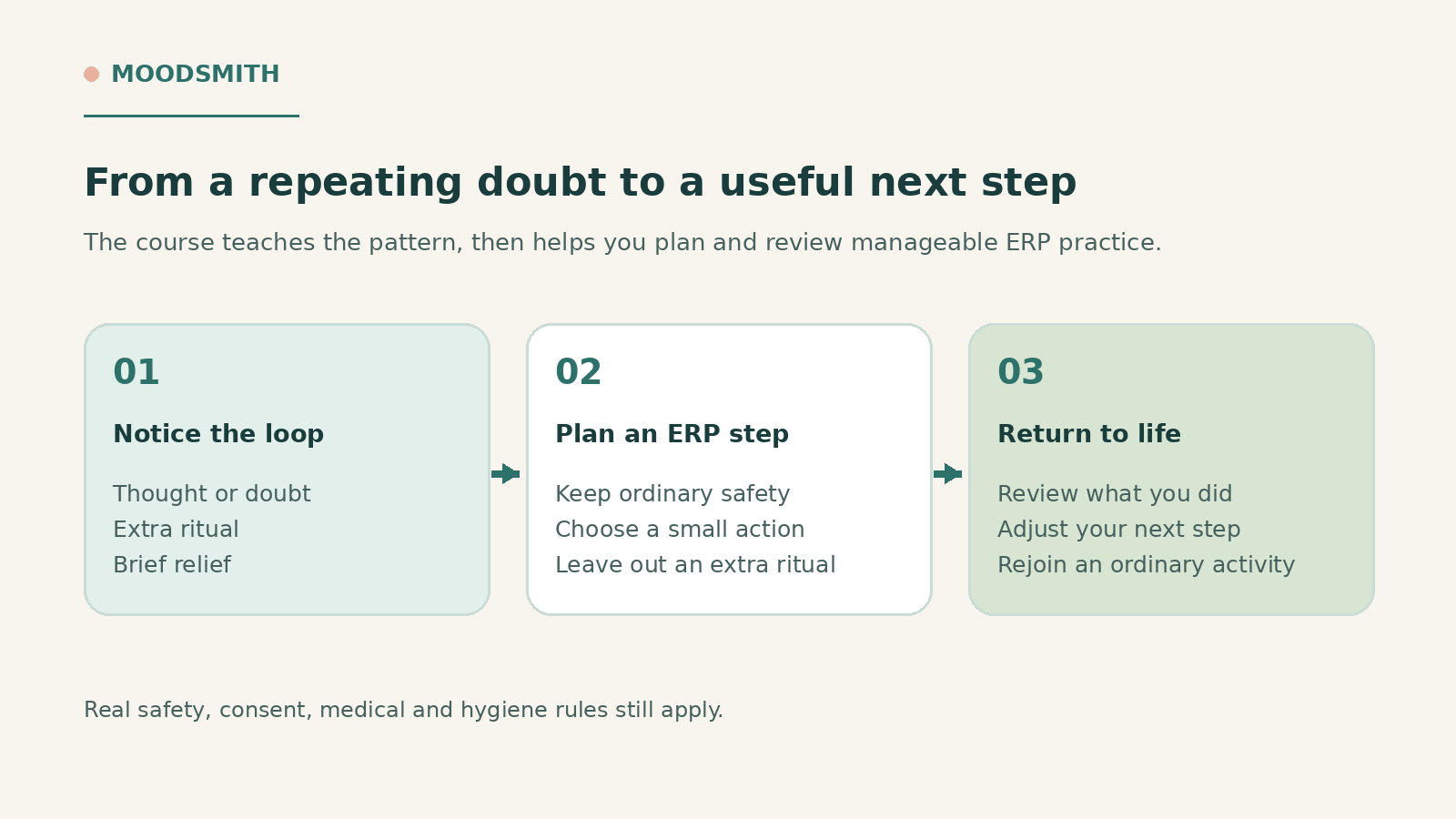
How the course works
Begin with the shared OCD cycle and the responses that keep it going. Then learn how to plan and try a suitable ERP step. Later lessons show how to apply the same approach to different OCD themes. Each of the 26 numbered lessons has a video, a worked example, a fillable worksheet, an activity and a short understanding check.