HOCD / Sexual Orientation OCD Self-Help Course
A structured CBT and ERP programme for intrusive doubts, checking, reassurance-seeking and the need to know for certain

If you are caught in repeated questions about your sexual orientation — analysing your feelings, checking your reactions, reviewing your past, monitoring your body or searching for reassurance — you may already know how exhausting the cycle can become.
This course is designed to help you stop treating every intrusive thought, feeling or sensation as a question that has to be answered.
Instead, I will teach you how to recognise the OCD cycle, identify the compulsions keeping it going, and begin responding differently using Cognitive Behavioural Therapy and Exposure and Response Prevention.
Created by Dr Elaine Ryan, Chartered Psychologist, with more than 20 years’ experience working with anxiety disorders and OCD.
You do not need to solve the question to recover from the OCD cycle
Sexual Orientation OCD — often called HOCD or SO-OCD — can make uncertainty feel urgent.
A thought appears. You notice a person, image, memory or physical sensation. Then the analysis starts:
What did that mean? Why did I notice that? What did I feel? What if I have been wrong about myself? What if this isn't OCD?
Trying to answer those questions can bring temporary relief. But the relief rarely lasts.
Before long there is another trigger, another doubt and another round of checking.
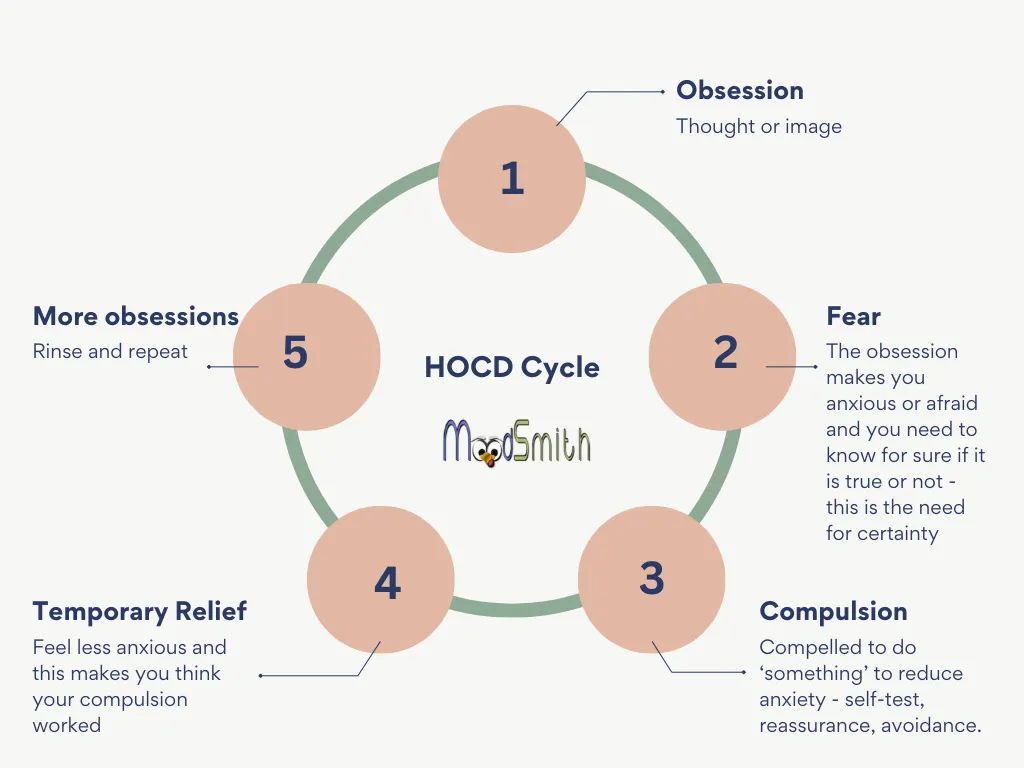
That repeating process is what this course focuses on.
The aim is not to prove a particular sexual orientation to you. The aim is to help you become less controlled by obsessive doubt and the compulsive things you do to try to remove it.
Look inside the course
92% said the course helped them with HOCD
97% would recommend the course to others
- Cognitive Behavioural Therapy CBT
- Exposure Response Prevention ERP
- Relaxation Training
- Anxiety Management
In the video below, I talk you through what is included in the course. The video shows the actual course to give you an idea of the structure.
I've been working as a psychologist for two decades and made the course to follow what would happen in session with me.
Does this sound familiar?
You may find yourself checking physical sensations or attraction, comparing your reactions to different people, replaying previous relationships or experiences, deliberately testing yourself, repeatedly searching online, asking other people for reassurance, avoiding people or situations that trigger doubt, or spending long periods mentally trying to work out what your thoughts “really mean.”
Some compulsions are obvious. Others happen entirely inside your head.
The important shift in recovery is learning to recognise the process rather than continually debating the content of the obsession.
What you will learn inside the course
The programme takes you progressively through the skills needed to understand and work with the HOCD cycle. You will learn how to:
- understand why intrusive thoughts, images and sensations can feel so convincing;
- recognise your individual obsession → anxiety → compulsion → relief cycle;
- identify checking, testing, reassurance-seeking, avoidance and mental reviewing;
- respond differently to intrusive thoughts rather than automatically analysing or neutralising them;
- understand CBT principles and apply them to Sexual Orientation OCD;
- use Exposure and Response Prevention to practise facing uncertainty without performing the usual compulsions;
- work with difficult feelings and physical sensations without treating them as evidence;
- use acceptance and mindfulness skills where they support your OCD work;
- practise the skills repeatedly so that OCD has less control over what you do.
Why CBT and ERP?
The central therapeutic approaches in this course are Cognitive Behavioural Therapy (CBT) and Exposure and Response Prevention (ERP).
ERP helps you encounter thoughts, feelings and situations that trigger uncertainty while learning not to perform the compulsive response you would normally use to obtain relief.
That might mean learning not to check a sensation, not to analyse a memory, not to ask someone for reassurance or not to spend the next hour trying to determine what a thought means.
Over time, the goal is not to become better at answering OCD.
It is to become better at not having to answer it.
CBT including ERP is recommended for OCD by both NICE and the NHS. NICE also includes structured self-help materials among lower-intensity treatment options for some adults with OCD. That does not mean NICE has assessed or endorsed this particular course; it means the therapeutic approach used within it is evidence-based.
Example Curriculum
Inside the programme
Part 1 — Understand what is happening
Learn how intrusive thoughts become obsessional, why anxiety makes thoughts feel important and how HOCD becomes a repeating cycle rather than a question you can solve through more analysis.
Part 2 — Find the behaviours keeping the cycle going
Identify reassurance-seeking, checking, mental reviewing, testing, avoidance and the less obvious compulsions that can happen entirely in your head.
Part 3 — Change your response to intrusive thoughts
Begin practising a different response to thoughts and images rather than fighting with them, suppressing them or trying to make yourself feel certain.
Part 4 — CBT for Sexual Orientation OCD
Understand the patterns of thinking that occur around OCD and learn how CBT can help you stop treating intrusive experiences as facts that demand immediate action.
Part 5 — Exposure and Response Prevention
Learn the principles of ERP and practise facing triggers and uncertainty while reducing the compulsive response that normally follows.
Part 6 — Acceptance, mindfulness and practical skills
Use additional psychological skills to help you notice thoughts and feelings without automatically becoming entangled in them.
Included: Anxiety MasterClass
Your enrolment also includes access to the Anxiety MasterClass currently bundled with the HOCD programme.